
AI Trends to Watch in 2026: Multi-Agent Systems, Physical AI, and Quantum Utility
Explore eight key AI trends expected by 2026, including multi-agent orchestration, digital labor workforces, physical AI, verifiable AI, and quantum utility.
Artificial intelligence is rapidly evolving, promising to revolutionize numerous aspects of our lives. Keeping abreast of the latest developments is crucial for businesses and individuals alike to prepare for the future. Predictions in the AI space are always difficult, but focusing on current trajectories can provide a useful guide.
This article will explore eight key AI trends expected to gain prominence by 2026. We'll delve into areas such as multi-agent orchestration, physical AI, verifiable AI, and more, offering insights into how these advancements might impact the world.
Key Points
- Multi-agent orchestration will become crucial for complex tasks, leveraging teams of AI agents specializing in different aspects of a problem.
- Digital labor workforces, composed of autonomous AI agents, will augment human capabilities through workflow execution and human-in-the-loop oversight.
- Physical AI, focusing on models that understand and interact with the real world, will drive advancements in robotics and automation.
- Social computing, with humans and AI agents operating within a shared AI fabric, will foster collaboration and collective intelligence.
- Verifiable AI, driven by regulations like the EU AI Act, will emphasize the importance of auditability, transparency, and data lineage for AI systems.
- Quantum utility will begin to emerge, with quantum computers reliably solving real-world problems alongside classical infrastructure.
Multi-Agent Orchestration
The year 2025 was touted as the “year of the agent,” and indeed, AI agents capable of reasoning, planning, and acting have emerged. However, no single agent excels at everything. In 2026, the focus will shift towards multi-agent orchestration, where teams of AI agents collaborate to tackle complex tasks.
This involves an orchestrator that coordinates the efforts of various specialized agents. For example, a planner agent might decompose goals into steps, while worker agents execute those steps, such as writing code or calling APIs. A critic agent can then evaluate the outputs and identify potential issues. This collaborative approach introduces cross-checking and breaks down problems into manageable steps.

Multi-agent orchestration diagram
The Rise of the Digital Labor Workforce
Another significant trend is the emergence of digital labor workforces. These are autonomous AI agents that can parse tasks by interpreting multimodal input and executing predefined workflows. These workflows involve a sequence of steps integrated into existing systems. Human-in-the-loop AI enhances these systems by providing oversight, correction, and strategic guidance to ensure agents operate as intended. This creates a force-multiplying effect, extending human capabilities.
This means that instead of a human manually completing a task, they can instruct an AI agent or a group of them, and then review and approve the outcome. It's worth noting that careful monitoring and guardrails are crucial to avoid unintended consequences.
Physical AI: Bridging the Digital and Physical Worlds
While large language models generate text and diffusion models create images, physical AI focuses on models that understand and interact with the real, 3D world. This involves models that can perceive their environment, reason about physics, and take physical action, such as in robotics.
Previously, programming robots required explicit rules defined by humans. Physical AI flips this around by training models in simulation to understand how objects behave in the physical world. These “world foundation models” can generate and understand 3D environments and predict what happens next in a physical scene. By 2026, these models will be instrumental in moving humanoid robots from research labs to commercial production.

Humanoid robot example
Social Computing: AI in a Collaborative Fabric
Social computing envisions a future where humans and AI agents operate within a shared AI fabric. In this environment, information flows seamlessly between agents and humans, enabling them to understand each other's intent and take coordinated action.
This shared space facilitates collaboration, context exchange, and effective understanding. The outcome is an empathetic, emergent network of interactions, creating what's termed “collective intelligence” or “real-world swarm computing.” This includes teams of agents, digital labor, humanoid robots, and technology that can understand human emotion through affective computing.
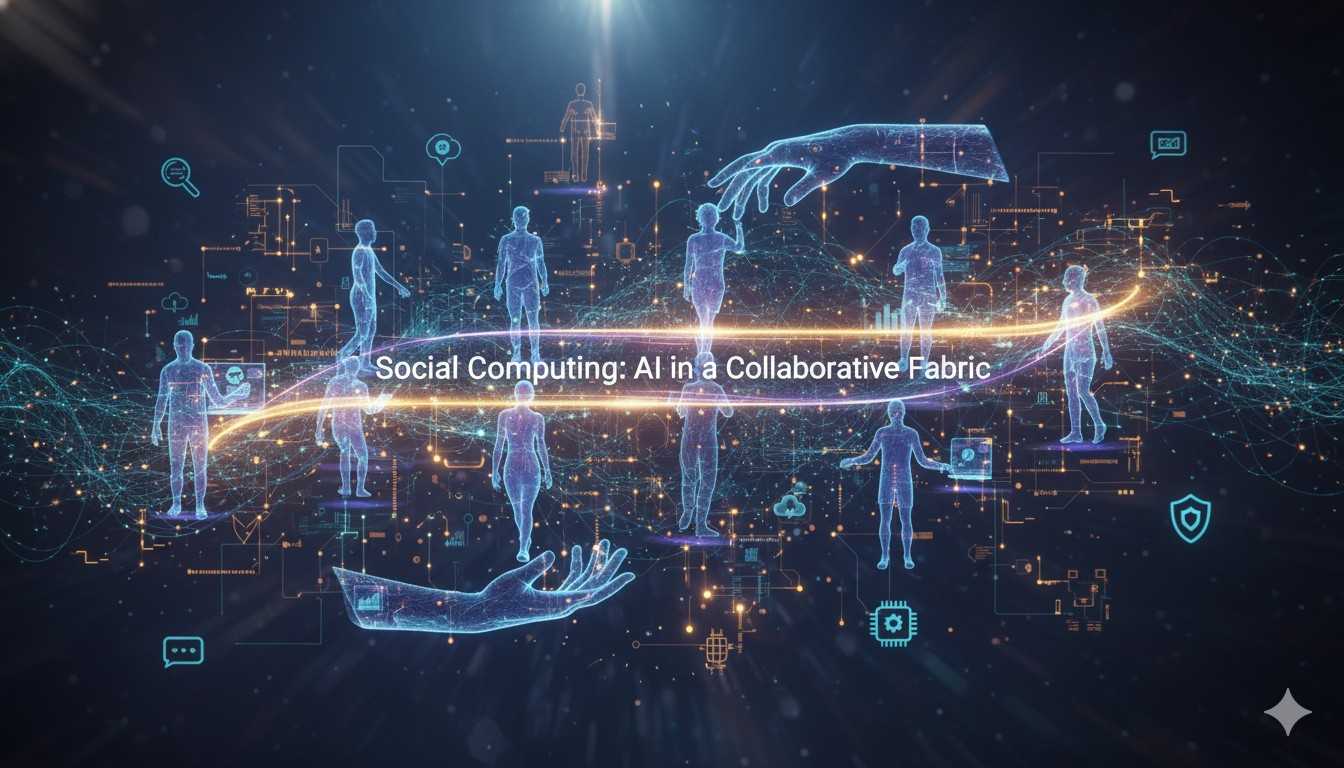
Social Computing example
Verifiable AI: The Dawn of AI Governance
With the EU AI Act becoming fully applicable by mid-2026, verifiable AI will become paramount. This act, similar to GDPR for AI, mandates that AI systems, especially high-risk ones, be auditable and traceable.
This means organizations developing and deploying AI need to provide technical documentation demonstrating compliance, including details on model testing and risk identification. Transparency is also essential, requiring users to be informed when they are interacting with a machine. Data lineage must be tracked to prove compliance with copyright and opt-out provisions. Just as GDPR influenced global privacy standards, the EU AI Act is expected to set the template for AI governance worldwide.

EU AI Act graphic
Quantum Utility Everywhere
2026 could mark the beginning of “quantum utility,” where quantum computing reliably solves real-world problems better, faster, or more efficiently than classical computing methods. At this point, quantum utility scale systems will begin working alongside classical infrastructure to deliver practical value in everyday workflows.
Quantum computing is expected to help with optimization, simulation, and decision-making – tasks previously out of reach for classical systems. This hybrid quantum-classical era could transform quantum computing into a mainstream paradigm, woven into everyday business operations. It's important to note that quantum computing is still in its early stages, and widespread adoption will take time.
Quantum computer visualization
Reasoning at the Edge
Small models, requiring minimal computing power, will gain the ability to “think” in 2026. While frontier models use inference time compute to spend extra time reasoning, teams have discovered how to distill this reasoning information into smaller models.
These smaller models, with only a few billion parameters, can perform reasoning offline, ensuring data never leaves the device and eliminating round-trip latency to data centers. This is particularly important for real-time or mission-critical applications where local reasoning is essential.

Edge computing diagram
Amorphous Hybrid Computing
Finally, we come to amorphous hybrid computing, a future where AI model topologies and cloud infrastructure blend into a fluid computing backbone. AI models are evolving beyond pure transformer designs, integrating state space models and other architectures.
Cloud computing is becoming differentiated by combining various chip types, including CPUs, GPUs, TPUs, and QPUs. Neuromorphic chips, emulating the brain, will also emerge. All these components will be integrated into a unified compute environment, where parts of each model are automatically mapped to the optimal compute substrate, maximizing performance and efficiency. While further out, DNA computing could also enter the mix in the future.
Practical Tips / Use Cases
- For businesses: Start exploring how multi-agent systems can automate complex workflows and improve efficiency. Consider pilot projects using digital labor to augment human capabilities.
- For developers: Invest in learning about world foundation models and physical AI to prepare for the growing demand for robotics and automation solutions.
- For policymakers: Familiarize yourselves with the EU AI Act and its implications for AI governance.
- For everyone: Stay informed about the potential benefits and risks of quantum computing and its impact on various industries.
Conclusion
The AI landscape is rapidly changing, with exciting developments on the horizon. By 2026, we can expect to see significant advancements in multi-agent systems, physical AI, verifiable AI, and quantum computing, among other areas. Staying informed about these trends is crucial for individuals and organizations to prepare for the future and harness the potential of AI. While the specific details are difficult to predict, focusing on these key areas provides a valuable guide.
For those working with AI-generated images or visual content, our image compressor can help optimize your files for web use. While AI continues to advance in creating and processing images, efficient compression remains essential for fast loading times and better user experience across all devices.
Ready to Compress Your Images?
Try our free online image compression tool. All processing happens in your browser - fast, private, and easy to use.
Related Articles
OpenAI's GPT Image 1.5: A Foundational Shift in Image Generation
GPT Image 1.5 delivers precision editing, 4x faster generation, enhanced text rendering, and insights into OpenAI's infrastructure investments.
OpenAI's GPT Image 1.5: Precision Editing and Blazing-Fast Image Generation
Explore OpenAI's GPT Image 1.5 with precision editing, 4x faster generation, and creative transformations. Learn how to leverage this powerful AI tool.